
Ranking first on Google used to be the finish line. A clinic that held the top local pack spot for “dentist Winnipeg” or “med spa Winnipeg” could reasonably expect that position to carry most of the weight in bringing new patients through the door. That’s no longer the whole picture.
More patients are getting their first answer from an AI tool before they ever open a Google results page, and a #1 ranking on Google doesn’t automatically carry over into being the name an AI tool recommends.
Two Separate Systems, Not One
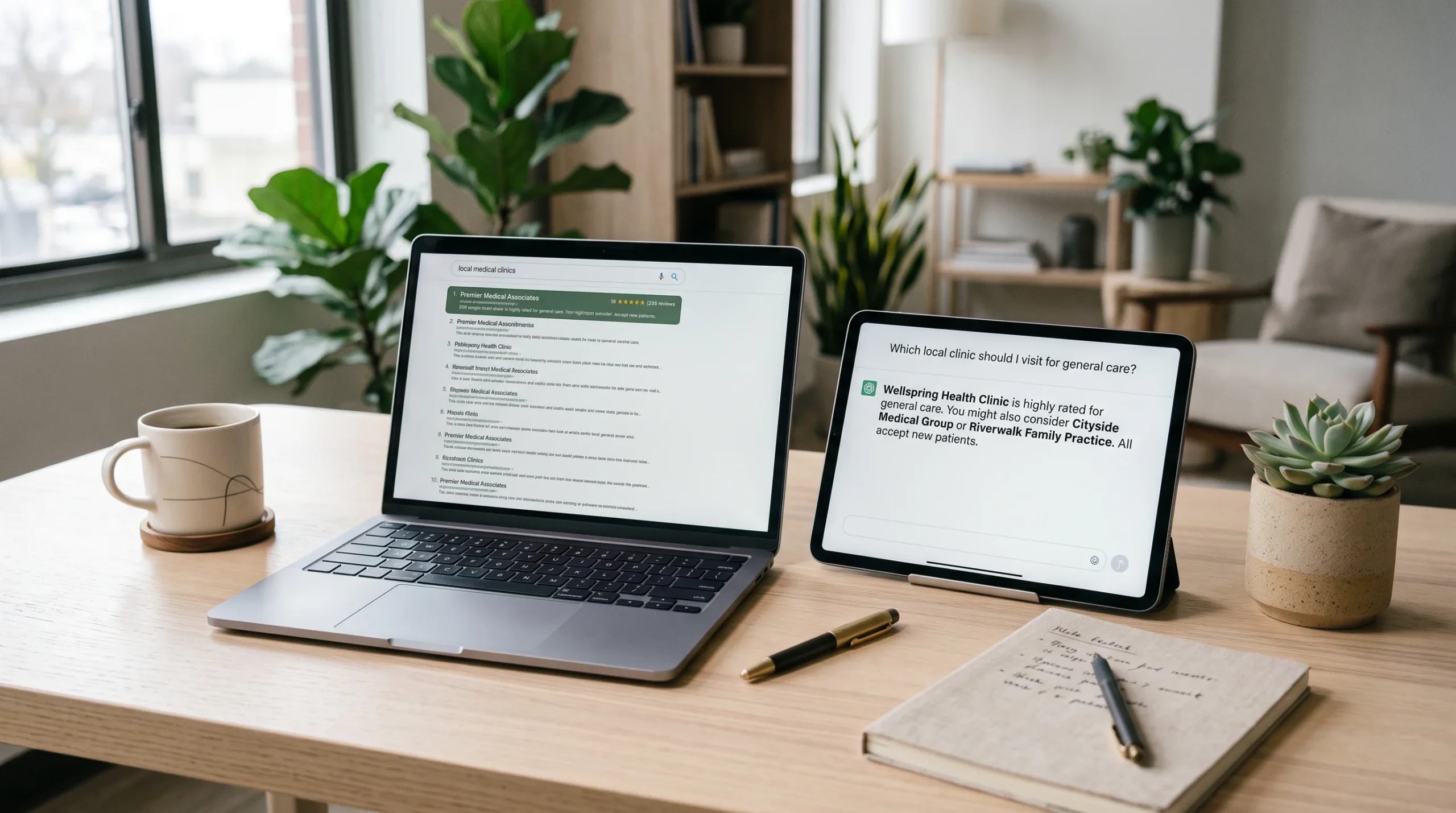
Traditional Google ranking and AI recommendation draw on overlapping but distinct signals. Google ranking rewards things like backlinks, page speed, and keyword relevance built up over time. AI tools lean more heavily on how clearly a page states what it is, how consistent your information is across the web, and how recent and specific your reviews are.
A clinic can rank well on Google through years of accumulated SEO work while still being invisible to an AI tool that’s reading the page fresh and looking for plain, well-structured answers rather than ranking signals.
What Winnipeg Clinics Are Missing
The clinics most likely to be skipped by AI tools tend to share a few traits: vague service pages that describe “comprehensive care” without naming specific treatments, Google Business Profiles that are out of date or incomplete, thin or old review history, and little to no structured data telling search engines and AI tools what the page actually contains.
None of these are unusual gaps. They’re common precisely because they were never a priority under a Google-only view of visibility.
Why This Matters More in a Local Market Like Winnipeg

In a smaller, more local market, patients often have several reasonable options within a short drive. When an AI tool is asked for a recommendation, it tends to name a short list, not a long one. Being left off that short list because your information wasn’t clear enough for the tool to use isn’t a ranking problem in the traditional sense. It’s a clarity problem.
Closing the Gap Between Ranking and Recommendation
The good news is that closing this gap doesn’t usually require a new strategy from scratch. It means auditing the same assets a clinic already has, its website, its Google Business Profile, its review presence, for clarity and completeness, and making sure structured data is in place so machines can read the page as easily as people can.
Frequently Asked Questions
If I already rank #1 on Google, do I really need to worry about this?
It’s worth checking rather than assuming. A top Google ranking and a strong AI recommendation are influenced by different signals, so it’s possible to have one without the other.
How is AI visibility actually measured?
There’s no single official metric yet. The most direct way to check is to ask AI tools the kinds of questions a patient would ask and see what comes back, alongside auditing the same on-page and structured-data signals that inform those answers.
Does this replace the need for ongoing SEO work?
No. Traditional SEO and AI visibility overlap in most of the fundamentals, so the work reinforces both rather than competing with each other.
Related Reading
- Your Next Patient Might Be Asking ChatGPT, Not Google — Is Your Clinic Ready?
- Local SEO vs. AI SEO (AEO): What Winnipeg Health Practices Need to Know About Both
- Google Business Profile Mistakes That Make AI Skip Your Clinic
- our web design services
Want to Know Where You Actually Stand?
A ranking check and an AI-visibility check are two different things, and it’s worth knowing the answer to both rather than just one. Maple Web Agency can walk through what that would look like for your clinic specifically, honestly and without promising outcomes we can’t guarantee.