If you ask five web designers about dental website cost in Canada, you may get five completely different answers. One might quote $1,500. Another will say $8,000. A large dental marketing company may come back with a five-figure proposal plus a monthly contract.
That does not necessarily mean someone is overcharging. It usually means the proposals do not include the same work.
In 2026, most professional dental practice websites in Canada fall somewhere between $2,500 and $15,000 CAD. A simple template-based site may cost less. A fully custom project with original copy, multiple service pages, online booking, local SEO and advanced integrations can easily exceed $20,000.
The more useful question is not simply, “How much does a dental website cost?” It is: what should your practice receive for that investment?
Dental website cost in Canada: a quick breakdown
These ranges are practical market estimates, not fixed industry rates. Location, scope and the provider you hire can move the final price considerably.
| Type of dental website | Typical 2026 cost in Canada | Usually best for |
|---|---|---|
| DIY website builder | $300-$1,000 per year | New practices with more time than budget |
| Basic template website | $1,000-$3,000 | Small clinics that need a simple online presence |
| Professional conversion-focused website | $3,000-$8,000 | Established practices that want more appointment requests |
| Custom dental website | $8,000-$20,000 | Competitive markets, cosmetic dentistry and growing clinics |
| Multi-location or advanced project | $15,000-$30,000+ | Dental groups, complex integrations and larger content requirements |
Public pricing guides published in 2026 show similarly wide ranges. That makes sense. A five-page template with supplied text is a very different product from a 25-page website built around local search, patient questions and measurable conversions.
All prices in this article are shown in Canadian dollars as general planning figures. Your actual quote should be based on a written scope.
What changes your dental website cost?
The price is rarely determined by the number of hours spent choosing colours. Most of the cost comes from the thinking, content and technical work behind the visible design.
1. The number of pages your practice needs
A basic dental website might include five pages: Home, About, Services, New Patients and Contact. That can be enough to establish credibility, but it gives search engines and patients very little detail.
A stronger site usually gives important treatments their own pages. Dental implants, Invisalign, emergency dentistry, cosmetic dentistry, root canals and children’s dentistry serve different patient needs. They also attract different searches.
Writing and building 15 useful pages costs more than assembling five broad ones. It also creates far more opportunities to be found.
2. Template design versus custom design

Templates are not automatically bad. A well-chosen template can be a sensible starting point for a new clinic. The problem appears when the finished website still looks like every other dental practice in the city.
Custom design takes more work because the layout, visual hierarchy and patient journey are shaped around the practice. The designer has to decide what a nervous new patient needs to see first, where booking buttons should appear and how services should be organized on mobile.
That extra thought is what you are paying for—not just a different shade of blue. Our guide on dental website design in Canada breaks down what separates a generic template from a site built to convert.
3. Professional copywriting
Many low-cost quotes assume the dentist will provide all the text. In practice, that task gets pushed aside between appointments and administrative work. The project slows down, and the final copy often sounds either too clinical or too generic.
Professional dental copy should explain treatment clearly without making exaggerated claims. It should answer real patient questions, reflect the clinic’s personality and guide the reader toward an appropriate next step.
Ask whether copywriting is included, how many pages will be written and whether the writer understands Canadian healthcare advertising requirements. “Content included” can mean anything from original interviews to lightly edited AI text.
4. Online booking and practice software integrations
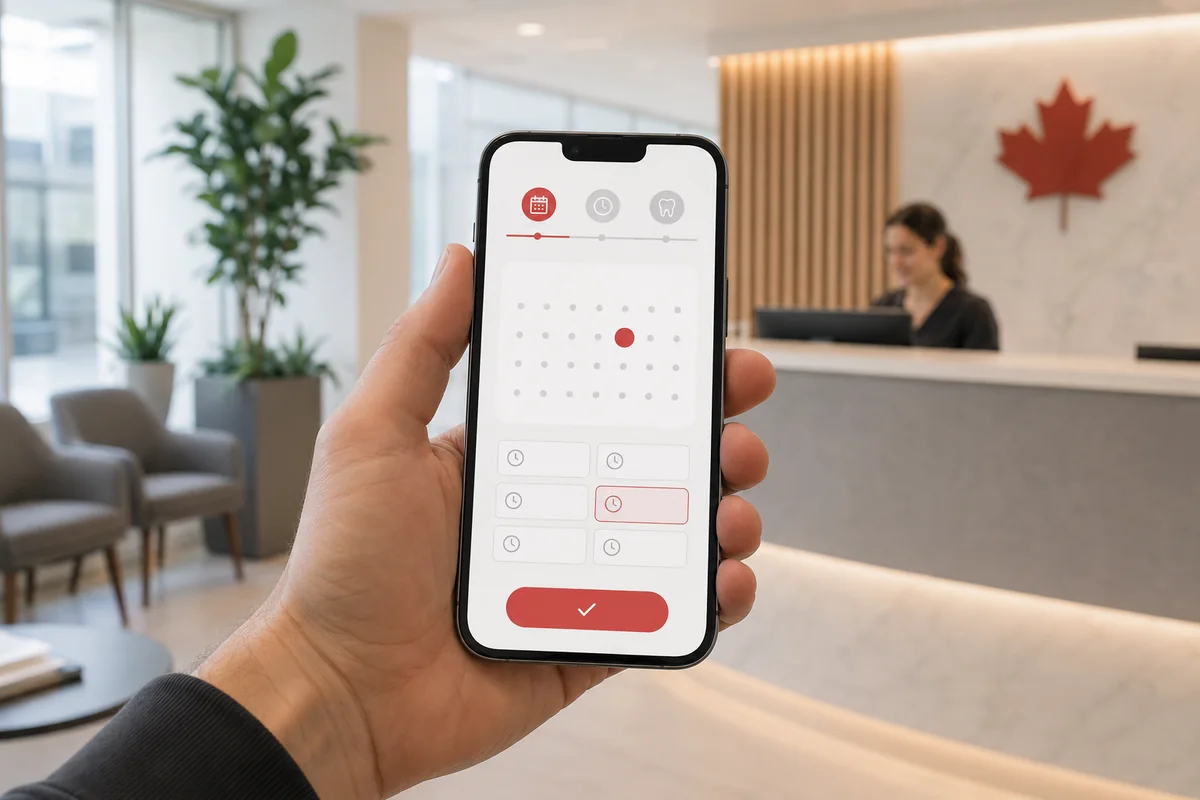
A contact form is relatively simple. A polished booking experience connected to software such as Jane, Dentrix, Curve Dental or another practice management system requires more planning and testing.
The cost may increase if the website needs:
- real-time appointment availability;
- different booking paths for new and existing patients;
- online intake forms;
- insurance or Canadian Dental Care Plan information;
- tracking for calls, forms and completed bookings;
- custom connections with third-party software.
The integration should feel like part of the website, not like an unrelated window that suddenly appears when someone clicks “Book.”
5. Local SEO
“SEO included” is one of the vaguest phrases in web design.
At a minimum, a dental website should launch with clear page titles, logical headings, crawlable navigation, optimized images, service-specific content, local business information and clean technical foundations. Google Search Console and analytics should also be connected.
Ongoing SEO is different. It may involve content production, location pages, Google Business Profile work, technical monitoring, link acquisition and regular improvements. That is normally priced separately.
A good proposal should tell you exactly where the website build ends and ongoing SEO begins.
6. Photography, video and before-and-after content
Original photography can change how a dental website feels almost immediately. Patients can see the clinic, the team and the environment before they arrive. Stock photos of perfect white smiles cannot create the same familiarity.
Photography and video are often separate expenses. So are consent management and the preparation of before-and-after galleries. If the clinic plans to use patient images or testimonials, the process should be reviewed against the rules of its provincial dental regulator.
7. Privacy, accessibility and security
Dental websites often collect names, contact details and information about appointment needs. That deserves more care than an ordinary newsletter form.
Canada’s privacy framework is not identical in every province. PIPEDA applies to many private-sector organizations that collect, use or disclose personal information in commercial activities, while provincial health privacy laws may also apply.
A web designer is not a substitute for a privacy lawyer. Still, the build should account for secure forms, limited data collection, clear consent language, SSL, software updates, backups and an accessible privacy policy.
Accessibility matters as well. Keyboard navigation, readable contrast, descriptive labels and sensible text sizes improve the experience for real patients. They should not be treated as optional polish.
8. Speed and mobile performance
Most patients will not admire a desktop homepage on a large monitor. They will open the site on a phone, often while comparing several clinics.
Heavy animations, oversized images and poorly configured booking tools can make an expensive site feel slow. Google’s Core Web Vitals measure real-world loading performance, responsiveness and visual stability. Good scores are not the whole of SEO, but poor performance can hurt both usability and conversions.
Performance testing, image compression and mobile quality assurance should be included in a professional build. For a closer look at what this involves, see our guide to mobile-first design for service businesses.
What should be included in a professional dental website?
A $5,000 quote can be better value than a $2,000 quote, but only if the scope justifies the difference. Before comparing totals, compare what is actually included.
A solid professional package should normally cover:
- a strategy or discovery call;
- mobile-first, conversion-focused design;
- a clear homepage and individual service pages;
- dentist and team profiles;
- a new-patient information section;
- appointment booking or lead-form integration;
- foundational on-page and local SEO;
- analytics and conversion tracking;
- speed, browser and mobile testing;
- SSL and basic security configuration;
- privacy and cookie requirements appropriate to the project;
- launch support and training;
- written confirmation that the practice owns the website and its content.
If several of these items are missing, the quote may be for design alone rather than a website ready to support patient acquisition.
The ongoing dental website cost clinics often forget
The build is only the first line in the budget. Every website has ongoing costs, even when the practice owns it outright.
Typical expenses may include:
| Ongoing item | Common planning range |
|---|---|
| Domain registration | $20-$50 per year |
| Hosting and routine maintenance | $50-$300 per month |
| Premium software or licences | $100-$1,000+ per year |
| Content updates and new pages | Quoted hourly or per project |
| Ongoing local SEO | $750-$3,000+ per month |
| Professional photography | $750-$3,000+ per session |
These figures vary considerably. The important part is transparency. Ask which fees are required, which are optional and what happens if you stop paying for maintenance.
Also ask whether the clinic can move the site to another hosting provider. Some low-upfront-cost companies lease websites rather than sell them. Leaving may mean losing the design, the content or the entire site.
How much should your dental website cost?
There is no universal “correct” budget for dental website cost, but the stage of the practice offers a useful guide.
A new or small practice: $2,500-$5,000
Focus on a credible mobile experience, core service pages, online booking, local SEO foundations and clean analytics. Avoid paying for elaborate features that the clinic will not use.
An established practice ready to grow: $5,000-$10,000
This range usually allows for stronger copy, more service pages, original visual direction, better conversion planning and deeper booking integration. It is often the practical middle ground for a clinic competing for high-value treatments.
A competitive or multi-location practice: $10,000-$25,000+
Multiple locations, extensive treatment content, custom photography, advanced tracking, accessibility reviews and software integrations require a larger scope. The website may also need separate location strategies without creating thin, repetitive pages.
The size of the practice is not the only factor. A single cosmetic dentist in a competitive urban market may need a more sophisticated site than a larger general practice in a less crowded area.
Is a cheap dental website cost worth it?
Sometimes it is. Understanding dental website cost trade-offs matters here: a new practice with a limited budget may be perfectly well served by a focused, professionally adapted template.
But low price becomes expensive when the site has to be rebuilt a year later. Common warning signs include:
- generic copy used by multiple dental practices;
- one page listing every service with no useful detail;
- poor mobile navigation;
- no ownership of the website or content;
- surprise monthly fees;
- slow pages loaded with unnecessary plugins;
- no conversion tracking;
- booking buttons that are difficult to find;
- promises of guaranteed first-place Google rankings.
The website does not need to be extravagant. It does need to be clear, fast, trustworthy and easy to use.

Questions to ask before accepting a proposal
You do not need to understand web development to evaluate a quote. Ask direct questions:
- Will we own the website, design and written content?
- Is the design custom, template-based or a combination of both?
- How many pages are included?
- Who writes the copy?
- Is appointment booking fully integrated and tested?
- What does “SEO included” mean in this proposal?
- Are analytics and conversion events configured?
- What privacy, accessibility and security work is included?
- What will we pay monthly after launch?
- Can we move the website to another provider later?
A reputable provider should be able to answer without hiding behind technical language.
A practical way to think about dental website cost
A dental website should not be judged only by how modern it looks on launch day. It should be judged by whether patients can find the practice, understand its services, trust the team and request an appointment without friction.
Consider a simple hypothetical example. If a better website creates only two additional qualified appointment requests per month, what would those patients be worth to the practice over a year? The answer will vary by treatment mix and acceptance rate, but it gives the website budget a business context.
No designer can honestly guarantee a specific number of patients. Search demand, competition, reputation, reviews, pricing and front-desk follow-up all affect results. The website is one part of the system—but it is the part many prospective patients see before they ever speak to your team.
Dental websites from Maple Web Agency
Maple Web Agency builds conversion-focused websites for dentists, med spas and medical practices across Canada. Projects are designed around clear appointment paths, mobile performance, trust and local search visibility.
Website builds currently start at $2,500, with the scope and price confirmed in writing before work begins. Strategy, booking integration, local SEO foundations, analytics and launch testing are included according to the project requirements.
If you are unsure whether your current website is helping or quietly losing patients, request a free website audit. You will receive a practical review of the issues affecting trust, search visibility and appointment requests—without pressure to rebuild everything.
Frequently asked questions
How much does a basic dental website cost in Canada?
A basic template-based dental website commonly costs between $1,000 and $3,000 CAD. The lower end may require the practice to supply its own copy, images and page structure. Confirm whether booking integration, mobile optimization and SEO setup are included.
How much does a custom dental website cost?
Most custom dental websites fall between $8,000 and $20,000 CAD, although complex or multi-location projects can cost more. The total depends on content, page count, design, photography, integrations and technical requirements.
Are there monthly fees after the website launches?
Usually, yes. Hosting, maintenance, software licences and ongoing SEO may be billed monthly or annually. Ask for a complete list of required and optional charges before signing a contract.
Does dental website design include SEO?
It should include a solid SEO foundation, but that is not the same as an ongoing SEO campaign. Clarify whether the proposal covers keyword research, service-page copy, technical setup, local optimization and post-launch content.
How long does it take to build a dental website?
A focused website can launch in one to three weeks when the scope is clear and content is available. Larger custom projects often take six to twelve weeks or longer. Delays usually come from copy approval, photography, integrations and feedback—not the coding alone.
Should a dental practice use Wix, Squarespace or WordPress?
Any of these platforms can support a useful website when configured well. The better choice depends on who will maintain the site, the required integrations, the content strategy and how much control the practice wants. Platform choice matters less than ownership, performance and execution.